

Table of Contents
- Why Pet Safe Home Cleaning Products Matter for Your Home
- Toxic Ingredients to Avoid in Pet Safe Cleaning Products
- DIY Pet Safe Cleaning Solutions You Can Make at Home
- Choosing a Non-Toxic Floor Cleaner for Pets
- Safe Cleaning for Floors, Surfaces, and Pet Accidents
- Eco-Friendly vs. Pet-Safe: Why They Are Not the Same
- Species-Specific Safety: Cats, Dogs, and Small Pets
- Conclusion
- Frequently Asked Questions
Last Updated: October 3, 2026
Why Pet Safe Home Cleaning Products Matter for Your Home
Most pet owners clean their homes more often than non-pet owners, yet many never stop to ask what those cleaners leave behind on the floor their dog licks.
The stakes are higher than most people assume. Pets spend their days at floor level, grooming their paws, and investigating every surface with their noses and tongues.
Common Ingredients That Put Pets at Risk
A short list of ingredients causes a disproportionate share of pet poisonings. Chlorine bleach, ammonia, and synthetic fragrances top the list, followed closely by phthalates and volatile organic compounds, or VOCs, which linger in the air long after the bottle is capped.
The American Society for the Prevention of Cruelty to Animals poison control guidance flags these categories as common culprits in household pet exposures. Ingestion risk rises sharply for cats, who groom constantly, and for small pets like rabbits and guinea pigs, whose body weight makes even small exposures significant.
How to Read a Cleaning Product Label
A label that says "natural" tells you almost nothing about safety. Manufacturers use that word loosely, and it carries no legal definition for cleaning products.
Here is what to actually look for:
- Ingredient list: A complete one, not just "surfactants" or "fragrance"
- "Pet-safe" or "pet-friendly" claims: Look for a named certifying body, not a marketing badge
- Ammonia-free and bleach-free statements: These matter because both ingredients cause respiratory and dermal irritation in pets
- pH-balanced formulas: Harsh alkalinity burns paws and noses
- Enzymatic cleaners: These break down organic waste rather than masking it
Toxic Ingredients to Avoid in Pet Safe Cleaning Products
Certain ingredients should trigger an automatic no when you are shopping for pet safe home cleaning products. The table below maps each one to the risk it poses and the safer swap.
Ingredient |
Risk to Pets |
Safer Alternative |
|---|---|---|
Chlorine bleach |
Respiratory irritation, burns |
Hydrogen peroxide (diluted) |
Ammonia |
Dermal and respiratory irritation |
Vinegar solutions |
Synthetic fragrances |
Allergic reactions, ingestion risk |
Unscented or essential-oil-free |
Phthalates |
Hormone disruption concerns |
Fragrance-free formulas |
VOCs |
Airway irritation |
Ventilated, low-VOC products |
Phenols |
Toxic to cats especially |
Enzymatic cleaners |
Cats are the group most often harmed by phenols, which appear in some disinfectants and even in certain essential oils.
DIY Pet Safe Cleaning Solutions You Can Make at Home
Making your own DIY pet safe cleaning solutions gives you full control over every ingredient. Three pantry staples cover most household jobs: vinegar, baking soda, and hydrogen peroxide.
Three Recipes Using Vinegar, Baking Soda, and Hydrogen Peroxide
All-purpose surface spray: Mix one part white vinegar with one part water in a spray bottle. Use it on counters, tile, and sealed surfaces.
Deodorizing carpet powder: Combine one cup of baking soda with a few drops of a pet-safe essential oil, or skip the oil entirely for cats.
Stain pre-treatment: Mix one part hydrogen peroxide with two parts water.
When DIY Falls Short and You Need a Store-Bought Option
DIY mixtures handle routine cleaning well, but they struggle with two jobs: true disinfection and deep odor neutralization. Vinegar does not kill parvovirus, and baking soda does not break down the proteins in pet urine.
For those cases, buy an enzymatic cleaner. These products use beneficial bacteria or enzymes to digest the source of the odor rather than covering it.
Choosing a Non-Toxic Floor Cleaner for Pets
The right non-toxic floor cleaner for pets depends entirely on your floor material. Using the wrong formula can damage the surface and leave a residue your pet then walks through and licks off.
Hardwood, Tile, and Carpet: Matching the Cleaner to the Surface
Hardwood needs a pH-balanced, residue-free cleaner. Excess water and harsh alkaline products dull the finish and seep into seams.
Tile and stone tolerate mild vinegar solutions, but skip anything acidic on natural stone. Grout lines trap residue, so rinse thoroughly.
Carpet is the hardest case because fibers hold onto whatever you apply.
Safe Cleaning for Floors, Surfaces, and Pet Accidents
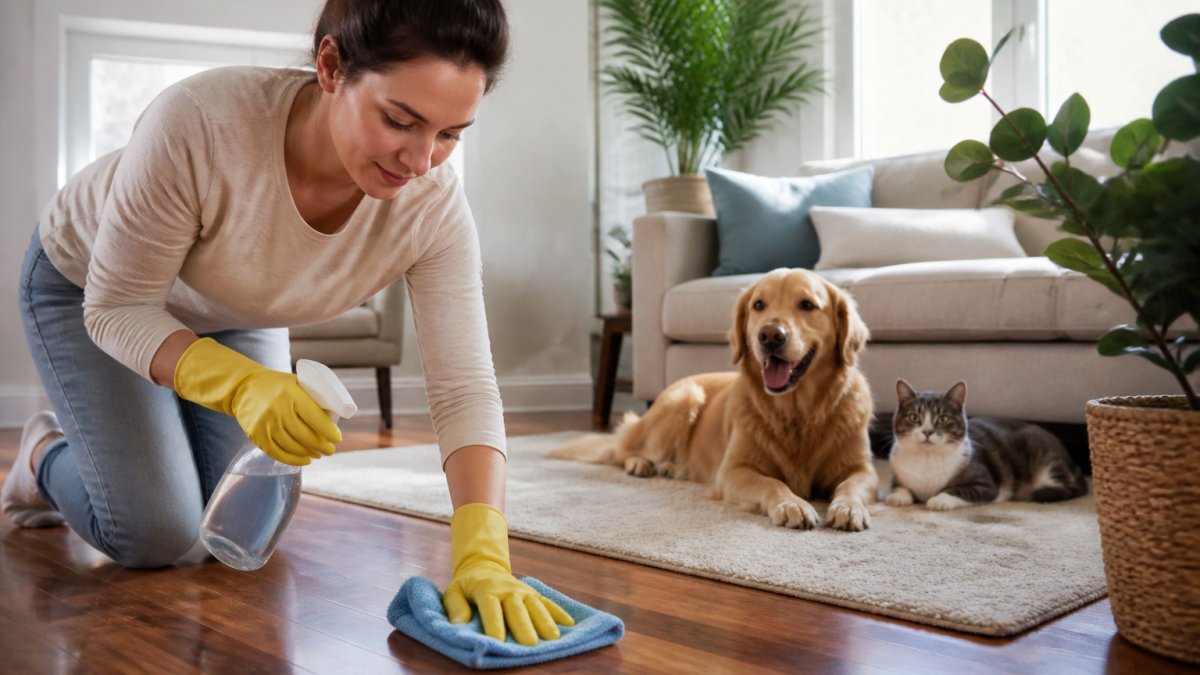
The core rule of safe cleaning is simple: remove the source, then rinse the surface. Many people clean the visible mess and stop there, leaving behind the residue that keeps drawing the pet back to the same spot.
Removing Pet Stains and Odors Without Harsh Chemicals
Pet accidents need a different approach than routine spills. Urine soaks into padding and subfloor, and its odor compounds reactivate with humidity. That is why a spot that seemed clean smells again on a rainy day.
Click the link below to see the full catalog of pet-friendly faux florals and greenery.
Follow this sequence:
- Blot up as much liquid as possible with a clean cloth
- Apply an enzymatic cleaner and let it dwell for the full time on the label
- Cover the area with a damp towel and let it sit
- Rinse with clean water and blot dry
- Repeat if the odor persists after drying
Dwell time is the step most people skip. Enzymatic cleaners need contact time to work, and rushing it means the odor returns.
Post-Cleaning Residue: What Lingers After the Mop Dries
Residue is the invisible problem in pet-safe cleaning. Even a safe product leaves a film if you use too much or skip the rinse step.
The fix is unglamorous: use less product than you think you need, and rinse with plain water. A microfiber cloth removes more residue than a paper towel, and it does not shed fibers onto the floor.
Eco-Friendly vs. Pet-Safe: Why They Are Not the Same
A product can be eco-friendly and still be unsafe for your pet.
Eco-friendly refers to environmental impact: biodegradable ingredients, recycled packaging, low water use in manufacturing.
The two labels answer different questions. If your priority is your pet, read for pet safety first and treat the eco label as a bonus.
Species-Specific Safety: Cats, Dogs, and Small Pets
Pet safe home cleaning products are not one-size-fits-all, because species process chemicals differently. This is the section most guides gloss over, and it is where real-world poisonings happen, an owner uses a product that is fine for the dog and triggers a reaction in the cat within hours.
Why Cats Are the Most Sensitive Group
Cats are not just "smaller dogs." Their livers lack a robust glucuronidation pathway, the enzyme system that many mammals use to break down and clear certain compounds. Phenols, essential oils, and several common disinfectant ingredients depend on that pathway to be safely eliminated. In a cat, those compounds accumulate instead of clearing, which is why a product that is harmless to a dog can be genuinely toxic to a cat.
That single biological fact explains most of the species gap:
- Phenols (found in some disinfectants and in essential oils like thyme and oregano) are poorly cleared by cats and can cause liver damage and neurological signs.
- Essential oils, tea tree, eucalyptus, peppermint, citrus, pine, and wintergreen are the most cited offenders. Diffusers concentrate them in the air, and cats groom the residue off their coats.
- Permethrin, a common insecticide in dog flea products, is severely toxic to cats. Never apply a dog flea product to a cat.
Dogs: A Wider Margin, Not a Free Pass
Dogs clear many of these compounds more efficiently, so their margin of safety is wider, but not unlimited. The risks that matter most for dogs are ingestion of concentrated product (bowls left on the floor, spills not wiped up) and respiratory irritation from aerosol sprays and strong VOCs. A dog that licks a freshly mopped floor is ingesting whatever residue the mop left behind, which is why the rinse step matters more than the product choice.
Birds: The Most Fragile Respiratory Systems
Birds have highly efficient respiratory systems, air sacs that extract oxygen on both inhale and exhale. That efficiency is also their vulnerability. Airborne VOCs, aerosol sprays, and even fumes from overheated nonstick cookware hit birds harder and faster than any other common pet. If you keep birds, ventilate well, avoid aerosol products entirely, and never clean a bird's room with a scented product while the bird is in it.
Small Pets: Rabbits, Hamsters, and Guinea Pigs
Small mammals live at floor level with constant grooming, so residue on a cage floor or playpen surface is a direct ingestion route. Their low body weight also means a small exposure is a proportionally larger dose. Stick to unscented, residue-free cleaners around their enclosures, and rinse twice.
A Quick Species-by-Species Rule of Thumb
Species |
Biggest Risk |
Safest Default |
|---|---|---|
Cats |
Essential oils, phenols, permethrin |
Unscented, phenol-free, rinse thoroughly |
Dogs |
Ingestion of concentrate, aerosols |
Diluted, rinsed, ventilated |
Birds |
Airborne VOCs and aerosols |
No aerosols, heavy ventilation |
Small mammals |
Floor residue, low body weight |
Unscented, double-rinsed |
When in doubt, the conservative choice, unscented, rinsed, and ventilated, is safe for every species in the house.
Conclusion
Getting pet safety right comes down to reading labels carefully, rinsing thoroughly, and matching your cleaner to both the surface and the species in your home. It takes a little more attention than grabbing the first bottle on the shelf.
Our hyper-realistic faux plants and floral arrangements are crafted from non-toxic materials that are safe for cats, dogs, and other companions, and they require zero maintenance, so there is no soil, no fertilizer, and no wilting greenery for a curious pet to chew. If you want a peaceful, pet-friendly home without the worry, browse our full catalog and find the arrangement that fits your space.
Frequently Asked Questions
What are the safest cleaning products to use around pets?
Look for products labeled pet safe cleaning with ammonia-free and bleach-free formulas. Ingredients like vinegar, baking soda, hydrogen peroxide, and enzymatic cleaners are generally safe when used as directed. Avoid synthetic fragrances, phthalates, and volatile organic compounds (VOCs). Always check the label for dwell time and rinse instructions, and keep pets away from treated surfaces until they are fully dry.
What ingredients should I avoid in cleaning products if I have pets?
Avoid ammonia, bleach, chlorine, phthalates, synthetic fragrances, and volatile organic compounds. These can cause dermal irritation, respiratory issues, or worse if ingested. Many essential oils, including tea tree and citrus, are toxic to cats and dogs even in small amounts. Choose products with natural ingredients and no added fragrance, or make your own DIY pet safe cleaning solutions with vinegar and baking soda.
Can I mop with Fabuloso if I have a dog?
Fabuloso contains synthetic fragrances and surfactants that can irritate a dog's respiratory system and paws. If you must use it, dilute heavily, keep your dog out of the room until the floor is completely dry, and rinse with plain water afterward. A non-toxic floor cleaner for pets, such as a vinegar-and-water solution, is a safer everyday choice for homes with dogs.
How can I make my house smell good without harming my pets?
Skip plug-in air fresheners and scented candles, which release VOCs and synthetic fragrances. Instead, simmer a pot of water with cinnamon sticks and apple slices on the stove, or place bowls of baking soda in rooms to absorb odors. For a light scent, use a few drops of pet-safe essential oils like lavender in a diffuser, but only in areas your pets cannot access.