

Table of Contents
- What Separates Realistic Faux Greenery From Cheap Plastic
- Best Faux Greenery for Home Decor: A Quick Comparison
- Where to Find Realistic Faux Greenery You Can Trust
- Non-Toxic Faux Plants for Pets: What to Check Before You Buy
- How to Style Artificial Plants So They Look Genuinely Alive
- Indoor vs. Outdoor Faux Greenery: UV-Resistance and All-Season Durability
- Maintenance and Cleaning: Keeping Faux Greenery Dust-Free for Years
- Conclusion: Choosing the Right Faux Greenery for Your Space
- Frequently Asked Questions
Last Updated: October 4, 2026
What Separates Realistic Faux Greenery From Cheap Plastic
Walk down any big-box artificial plant aisle and you will spot the difference in seconds: shiny leaves, single-tone green, stems that snap back like wire.
At Spotteddonkey, we built our collection around that gap. Most shoppers searching for where to find realistic faux greenery have already been burned by something that looked convincing online and cheap on the console table.
Materials That Make the Difference: Polyethylene, Polysilk, and Real-Touch Finishes
Polyethylene is a molded plastic used for leaves and succulents because it holds shape and takes detailed veining. Polysilk blends fabric and plastic for fronds that move and drape like real foliage. Real-touch describes a flocked or coated finish that mimics the soft, fuzzy surface of plants like lamb's ear or eucalyptus.
Each material suits a different plant. A Boston fern needs polysilk fronds so sprigs separate and hang naturally; a snake plant or agave needs molded polyethylene to hold its architectural line. One cheap material used for everything reads as fake from across the room.

How to Spot Quality in Person and in Photos
Check the stem first. Quality faux greenery uses plastic-coated wire stems, which bend and hold a pose. Cheap versions use rigid plastic that kinks or snaps.
Then look at color. Real leaves shift from deep green at the base to lighter, yellower tips, and quality manufacturers replicate that gradient.
Finally, touch the surface. Flocked and real-touch finishes feel soft and matte; glossy leaves reflect light the way real foliage never does, which is why they photograph badly in a bright room.
Best Faux Greenery for Home Decor: A Quick Comparison
Most buying guides sort faux greenery by room or plant type. The sort that actually predicts realism is construction method, because construction determines how foliage catches light, how it drapes, and how long it survives before reading as plastic.
Here is how the main construction categories compare, with the trade-offs that matter.
| Construction | How It Is Made | Best For | Realism Ceiling | Typical Failure Mode |
|---|---|---|---|---|
| Injection-molded polyethylene | Molten plastic injected into a leaf-shaped mold with engraved veining | Succulents, snake plants, agave, monstera | High for stiff, architectural leaves | Shiny surface if not matte-finished; uniform color if not hand-tinted |
| Silk-screen fabric leaves | Fabric cut and printed, then glued or heat-sealed to a wire stem | Ferns, eucalyptus, olive branches, loose stems | High for soft, draping foliage | Frays at cut edges; print fades faster than molded color |
| Polysilk blend | Fabric-and-plastic composite extruded as a single frond | Boston ferns, hanging baskets, trailing ivy | Very high for movement and separation | Can crush permanently if stored under weight |
| Real-touch flocked | Base leaf dipped or sprayed with a soft fiber layer | Lamb's ear, dusty miller, sage, eucalyptus | Highest for texture under fingertips | Flocking sheds if rubbed hard; not for high-traffic arrangements |
| Foam-and-wire | Foam core wrapped in fabric, shaped by hand | Topiary, moss balls, structured hedges | Moderate; reads best at distance | Foam crumbles in humid outdoor conditions |
Reading the Trade-Offs Before You Buy
Molded polyethylene wins on durability, loses on drape. A molded snake plant holds its line for years, but a molded fern looks wrong because real fronds bend and separate.

Real-touch finishes win on close inspection, lose on durability. A flocked eucalyptus stem is the most convincing piece for a dining table, but it sheds fibers if handled often.
Foam-and-wire wins on shape, loses on climate. Topiary and moss balls look great in a covered entry, but foam absorbs moisture; in a humid climate or uncovered patio, cores soften and deform within a season.
Matching Construction to the Room
A few practical pairings that hold up in real homes:
- Low-light entryway corner: injection-molded polyethylene floor plant. It needs no light, holds shape, and dusts clean with one pass.
- Dining table centerpiece: real-touch or polysilk loose stems in a narrow vase. Seen up close, texture matters more than durability.
- Covered patio: UV-treated polysilk hanging plants. Fabric blends handle temperature swings better than molded plastic, which can become brittle in cold snaps.
For a mixed arrangement, combine constructions rather than buying a single-material bundle. A molded base plant with silk-screen filler stems and one real-touch accent gives layered texture that reads as genuinely alive.
Where to Find Realistic Faux Greenery You Can Trust
Specialty retailers consistently outperform general merchandise stores on realism: a boutique seller stakes its reputation on how convincing the product looks in a customer's home, while a big-box buyer optimizes for shelf volume and price point.
That difference shows in the details: molded leaf veining, multi-tone coloring, weighted bases, display-worthy pots, and product photography honest about texture instead of hiding it behind moody lighting.
Why Boutique Retailers Beat Big-Box Selection
Boutique selection is curated rather than exhaustive. Instead of forty variations of the same fern, you get a smaller range chosen for how well each piece reads as real, which matters when buying one statement plant rather than filling a warehouse shelf.
Specialty sellers also stock pieces that solve specific problems: UV-protected hanging plants for a covered patio, real-touch stems for a dining table, potted arrangements for renters who cannot drill into walls.

Non-Toxic Faux Plants for Pets: What to Check Before You Buy
Non-toxic faux plants for pets are artificial greenery made without the heavy-metal stabilizers and harsh solvents found in some low-cost imports, which matters because cats and dogs do chew on leaves.
No artificial plant is a chew toy, so still place arrangements out of reach of determined pets.
A few practical checks before you buy:
- Confirm the seller describes the material and its safety for households with pets
- Avoid products with a strong solvent odor out of the packaging
- Skip arrangements with loose, easily detached small parts if you have a chewer
Spotteddonkey crafts its collection from non-toxic materials specifically for pet-friendly homes, which is one of the reasons we hear from cat and dog owners who had given up on live plants entirely.
Faux Snake Plant, Potted, Black, 30 in →
How to Style Artificial Plants So They Look Genuinely Alive
How to style artificial plants comes down to one principle: fight the symmetry. Real plants grow toward light, so they lean, drape, and fill space unevenly.
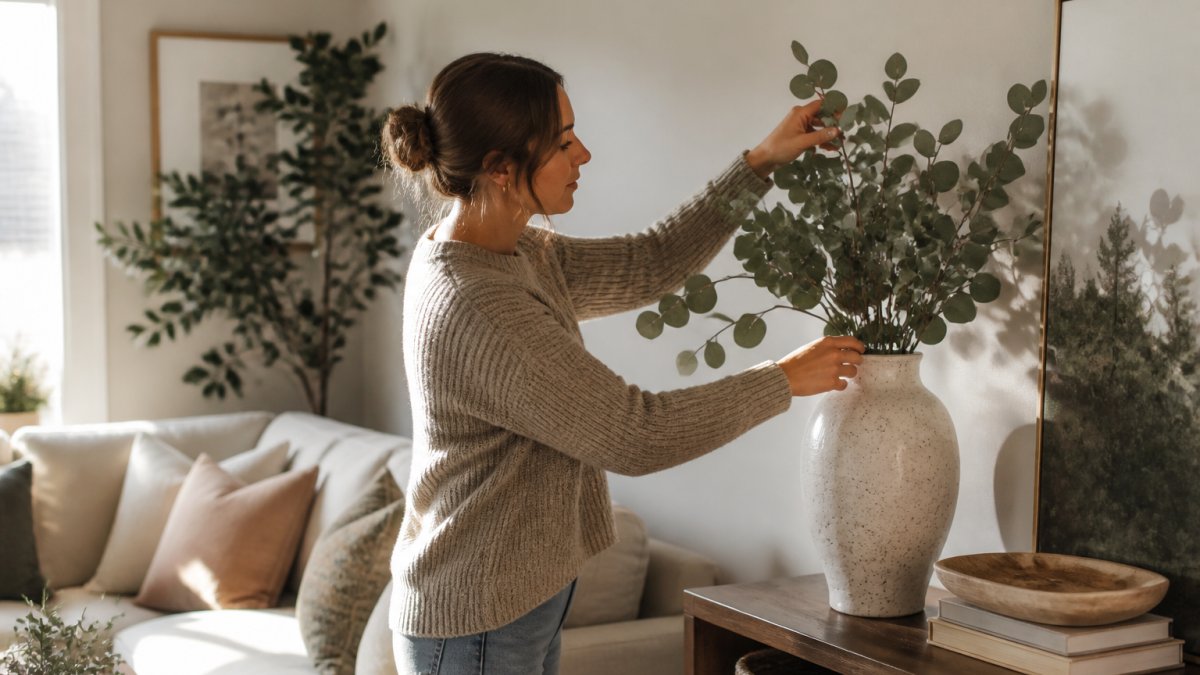
Start by fluffing. Stems get compressed in shipping, so separate every branch and bend the wire core gently outward. Then arrange in odd numbers, because even-numbered groupings look staged. Let one stem drape lower than the rest.
Fluffing, Bending, and Arranging Stems for a Natural Drape
Work from the bottom up: bend the lowest branches outward and slightly down, angle middle stems out at varying degrees, and leave the top few upright. The goal is an irregular silhouette.
Vary heights across a shelf or mantel rather than lining everything up. A tall potted plant beside a low bowl arrangement creates the layered, lived-in look.
Indoor vs. Outdoor Faux Greenery: UV-Resistance and All-Season Durability
UV-resistant faux greenery is not a marketing label but a specific additive package blended into plastic or fabric during manufacturing. Understanding what it does, and does not do, is the difference between a patio arrangement that holds color for three seasons and one that turns chalky by August.
What UV Resistance Actually Means
Ultraviolet light breaks down polymer chains in plastic and dye molecules in fabric. The visible result is fading; the structural result is worse, the material becomes brittle, leaves crack at the stem joint, and the piece sheds. UV stabilizers, typically hindered amine light stabilizers (HALS) or UV absorbers, interrupt that breakdown at the molecular level.
Three things determine how well a piece survives outdoors:
- Whether stabilizers were added at all. Untreated polyethylene and polyester will fade noticeably within one summer of direct sun.
- How much was added. A product rated for a covered porch needs less stabilizer than one rated for full sun. Sellers rarely publish the loading, but they do publish the intended exposure.
- Whether the colorant is UV-stable. Some pigments fade faster than others. Deep greens and reds are more prone to fading than muted olives and grays.
Matching the Product to the Exposure
Not every outdoor spot is the same. A covered porch never sees direct sun; a south-facing balcony sees it all day. Match the product to the exposure, not just the word "outdoor."
- Covered porch or entryway: standard UV-treated faux greenery is sufficient. Look for products labeled UV-protected for indoor and outdoor use.
- Full-sun patio or balcony: look for products explicitly rated for direct sun exposure, and expect to replace them every two to three seasons even with good care.
- Pool deck or coastal area: salt and chlorine accelerate fading. Rinse the foliage monthly with fresh water to remove residue.
Indoor Conditions Are Not Benign Either
Indoor faux greenery avoids UV damage but faces three other stressors:
- Dry air and forced heat can make low-grade fabric leaves curl at the edges. Molded polyethylene is unaffected.
- Dust accumulation is the single biggest visual problem indoors. A dusty leaf reads as gray and flat, which is what makes cheap faux greenery obvious in a bright room.
- Direct sun through a window still fades untreated fabric over time, especially on a south- or west-facing sill. If a piece sits in a sunbeam, treat it as an outdoor piece for fading purposes.
A Simple Durability Checklist
Before buying for any outdoor or sun-exposed spot, confirm:
- The product is labeled for the specific exposure (covered vs. direct sun)
- The material is named (polyethylene, polysilk, polyester) rather than left generic
- The pot or planter is rated for outdoor use, since a cheap pot will crack before the foliage fades
A well-made UV-treated piece will hold its color for two to three outdoor seasons in most climates. A poorly made one will look tired by the end of the first. The difference is almost always in the additive package, not the plant variety.
Maintenance and Cleaning: Keeping Faux Greenery Dust-Free for Years
Dust is the only real enemy of artificial greenery, and it is easy to beat. A dusty faux plant looks gray and tired, the most common reason people give up on artificial decor.
Clean most pieces with a microfiber cloth or feather duster every few weeks. For a deeper clean, take the arrangement outside and use a hair dryer on cool to blow dust out of dense foliage.
A few habits that keep faux greenery looking new:
- Dust every two to four weeks, more often in dry climates
- Keep arrangements out of direct, intense sunlight unless they are UV-protected
- Store spare stems flat and loosely wrapped when swapping seasonal decor
Conclusion: Choosing the Right Faux Greenery for Your Space
The hard part is not finding artificial plants, but finding ones that hold up to close inspection, survive your climate, and stay safe around the pets and people in your home.
Spotteddonkey exists for exactly that problem. Our collection is precision-engineered to withstand harsh climates, crafted from non-toxic materials safe for cats and dogs, and finished with hyper-realistic detail that makes guests do a double take.
Browse the full catalog and find the arrangement that finally makes your space feel finished.
Frequently Asked Questions
Where can I buy realistic looking fake plants?
Boutique retailers that specialize in hyper-realistic faux greenery tend to offer better quality than big-box stores. Look for shops that describe materials in detail (polyethylene, polysilk, real-touch finishes) and show customer photos. Spotteddonkey, for example, carries potted faux snake plants, orchid arrangements, and eucalyptus stems with lifelike textures. Reading reviews and checking material specs before buying helps you avoid the plastic look that cheaper options often have.
How can you tell if faux greenery is high quality?
High-quality faux greenery uses materials like polyethylene or polysilk that mimic natural leaf texture and veining. Check for varied coloring (not uniform green), realistic stem structure with wire cores you can bend, and weight that feels substantial. Real-touch finishes and flocked details, like those on lamb's ear stems, signal better craftsmanship. If a product description mentions specific materials and construction details rather than generic claims, that's a good sign.
Are there non-toxic faux plant options for pet owners?
Yes. Many faux plants are made from non-toxic materials like polyethylene and polysilk, which are safe for cats and dogs in normal household conditions. When shopping, look for product listings that explicitly state non-toxic or pet-safe materials. Avoid vintage or unlabeled artificial plants that may contain lead-based paints or unknown plastics. Spotteddonkey prioritizes non-toxic materials across its collection, making it a reasonable starting point for pet-friendly homes.
What materials make artificial plants look most realistic?
Polyethylene and polysilk are the two most common materials for lifelike faux greenery. Polyethylene gives leaves a natural matte finish and realistic texture, while polysilk fronds mimic the softness of real foliage. Real-touch coatings and flocked finishes add softness, as seen on lamb's ear stems. UV-resistant treatments prevent fading outdoors. The combination of material quality, varied coloring, and detailed veining is what separates hyper-realistic plants from obvious fakes.