

Table of Contents
- What Makes High-Quality Artificial Flowers Look Realistic
- How to Choose Artificial Flowers That Feel and Look Right
- Artificial Flowers That Look Real: Material Differences and Trade-Offs
- Silk Flowers vs. Real Touch Flowers: Which Option Wins
- How to Make Fake Flowers Look Real in Your Home
- Your Inspection Checklist for Spotting High-Quality Faux Flowers
- Durability, Care, and Fading: What to Expect Long-Term
- Value and Price-Quality Assessment
- Frequently Asked Questions
Last Updated: October 7, 2026
What Makes High-Quality Artificial Flowers Look Realistic
The difference between a high-quality artificial flower and a cheap knockoff often comes down to details most people overlook until they see them side by side.
Real flowers have complexity built into every layer. Petals vary in color, thickness, and texture. Leaves aren't uniform green; they have veins, subtle shading, and natural imperfections. When manufacturers invest in replicating these details, the result feels alive in a way that generic artificial flowers simply don't.
Petal Shape, Layering, and Texture
The most convincing artificial flowers use multiple techniques to mimic nature's subtlety. Look for flowers with individually shaped petals rather than molded blooms where every petal looks identical.
Layering matters tremendously. A realistic bloom has petals at different depths, creating dimension and shadow play.
Texture is where quality truly separates itself. The Artificial Hydrangea Stem with Real Touch PEVA Petals from Spotteddonkey features 182 individual petals crafted from soft PEVA material, which creates that genuine tactile experience collectors seek.

Natural Color Variation and Tonal Detail
Uniform color is the enemy of realism. Real flowers have subtle color shifts across their blooms, darker at the center, lighter at the edges, with occasional deeper tones suggesting shadows or natural bruising.
Look for flowers where the color isn't flat.
Spotteddonkey's Designer's Pick Real Touch Dahlia demonstrates this principle with rich color depth and beautifully structured form that florists and interior designers value specifically for its lifelike appearance.
How to Choose Artificial Flowers That Feel and Look Right
Choosing artificial flowers that look real requires understanding the materials and construction methods that separate premium options from budget alternatives. The best approach combines tactile inspection with visual assessment, because what feels right often looks right.
The Touch Test: Matte Versus Shiny Surfaces
Run your hand across the petals. High-quality artificial flowers have a matte finish that mimics the natural sheen of fresh blooms.
The surface finish also affects how the flower photographs. Matte petals photograph more naturally in various lighting conditions, which matters if you're documenting your arrangements for social media or personal records.
Feel the stem and leaves too. They should have some texture, not be perfectly smooth plastic. Quality artificial flowers use flexible materials for stems that allow you to bend and position them without snapping.
Stem and Leaf Flexibility
Bend the stem gently. A high-quality artificial flower stem should flex without resistance and hold its shape once positioned. Brittle stems that snap easily or stems that spring back to their original position indicate lower construction quality.

Leaves deserve the same attention. Pinch a leaf gently between your fingers. Quality leaves have some give; they don't feel rigid or brittle.
Check how leaves attach to the stem. Secure attachments mean leaves won't shift or fall off during arrangement or transport. Loose leaves that move around suggest rushed manufacturing and lower durability.
Artificial Flowers That Look Real: Material Differences and Trade-Offs
Different materials create different aesthetic and functional outcomes. Understanding these trade-offs helps you choose flowers that match your specific needs and space.
Silk-like polyester offers elegance and a traditional aesthetic. It photographs beautifully and has a natural sheen that works well in formal arrangements.
PEVA and other real-touch materials provide exceptional tactile realism. Real-touch materials typically resist dust accumulation better than silk alternatives and maintain their appearance with minimal maintenance.
Polyester blends offer durability and color retention. Higher-quality blends resist fading better, which matters if your flowers receive indirect sunlight.
The moisturizing coating used on premium artificial flowers like Spotteddonkey's offerings creates a fresh-cut appearance that mimics the subtle sheen of recently harvested blooms.
Silk Flowers vs. Real Touch Flowers: Which Option Wins
The choice between silk and real-touch artificial flowers depends on your priorities and how you plan to use them.
Silk flowers excel in formal settings and traditional arrangements. They have an elegant, refined appearance that works beautifully in classic interiors.
Real-touch flowers win for casual arrangements and spaces where guests might handle them. The tactile experience of touching a realistic petal creates an emotional connection that silk can't quite match.
For most homes, real-touch flowers offer the better balance. They look realistic, feel pleasant to touch, and require minimal maintenance.
How to Make Fake Flowers Look Real in Your Home
Arrangement technique matters as much as flower quality. Even premium artificial flowers look artificial if arranged incorrectly.
Scale, Proportions, and Realistic Arrangement
Mix flower sizes and types rather than creating uniform arrangements. Real bouquets have variety. Include some flowers in full bloom, some partially open, and some with visible buds.
Artificial Rose Stem, Real Touch Moisturizing Coating, 21.5 Inch →
Pay attention to height variation. Arrange flowers at different levels rather than in a flat plane.
Use appropriate containers. A single stunning artificial rose in a simple vase looks more realistic than ten identical roses crammed together. Quality matters more than quantity.
Consider your space's lighting. Artificial flowers look most convincing in areas with natural light or warm artificial lighting.
Construction Quality and Secure Attachments
Inspect how petals attach to the flower head. They should be sewn or securely glued, not loose or easily pulled away. Loose petals indicate rushed manufacturing and suggest the arrangement will deteriorate quickly.
Check stem construction. The stem should feel substantial, not hollow or flimsy. Quality stems have consistent thickness and don't bend or kink easily.
Examine leaf attachments. Leaves should be firmly attached to the stem, not sliding around or falling off with gentle handling. Quality construction means your arrangement stays beautiful through moves, cleaning, and regular handling.
| Quality Indicator | High-Quality Flowers | Lower-Quality Flowers |
|---|---|---|
| Petal texture | Soft, varied, matte finish | Slick, uniform, shiny plastic |
| Color variation | Tonal depth, realistic shading | Flat, single-tone color |
| Stem flexibility | Bends and holds position | Brittle or springs back |
| Leaf detail | Visible veining, secure attachment | Smooth, loose, or falling off |
| Overall feel | Natural, pleasant to touch | Plastic, artificial sensation |
Your Inspection Checklist for Spotting High-Quality Faux Flowers
Use this practical checklist when evaluating artificial flowers in person or through detailed photos online.
- Petals have individual shaping, not molded uniformly
- Color shows tonal variation across the bloom
- Petal surface feels matte, not shiny or plastic-like
- Layering creates visible depth and shadow play
- Stem bends smoothly and holds its position
- Leaves have visible veining and texture
- Leaf and petal attachments are secure and tight
- Overall flower feels pleasant to touch, not brittle
- Bloom size matches realistic proportions for that flower type
- No visible glue residue or sloppy construction
- Color consistency across the entire arrangement
- Stems and leaves don't feel hollow or flimsy
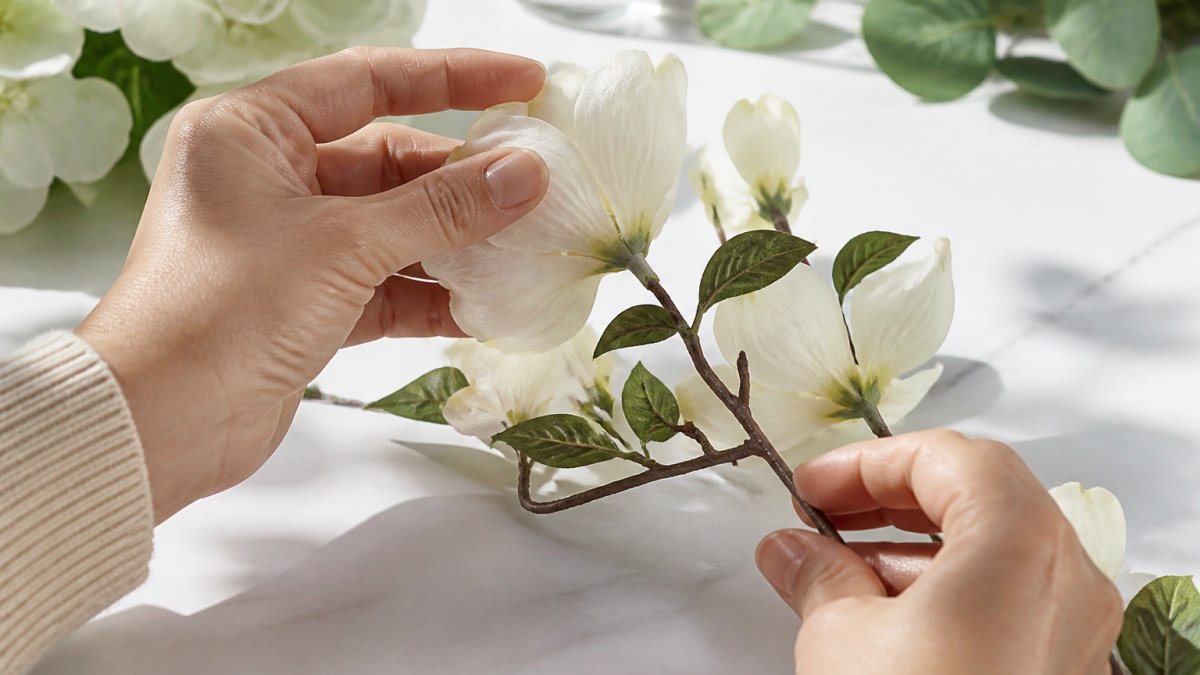
This checklist works whether you're shopping online (using product photos and customer reviews) or examining flowers in person. Pay special attention to any photos showing close-up details of petals, stems, and leaves. These details reveal construction quality better than full-bloom shots.
Durability, Care, and Fading: What to Expect Long-Term
High-quality artificial flowers maintain their appearance far longer than budget alternatives, but they're not permanent.
Direct sunlight fades artificial flowers over time, though premium options resist fading significantly better than budget alternatives. Placement away from direct sun extends the lifespan considerably.
Dust accumulation happens naturally. Avoid harsh cleaning products that might damage the material or coating (pubmed.ncbi.nlm.nih.gov).
Temperature extremes can affect some materials. Avoid placing artificial flowers near heating vents, air conditioning units, or in extremely hot spaces.
Quality artificial flowers from premium retailers like Spotteddonkey maintain their beauty for years with minimal care.
Value and Price-Quality Assessment
Price and quality don't always correlate perfectly, but they're generally related. Understanding what drives pricing helps you make informed decisions about value.
Premium artificial flowers cost more because they use better materials, employ more skilled labor, and invest in realistic details.
Consider cost per year of use.
Spotteddonkey's offerings reflect this value proposition. The Designer's Pick Real Touch Dahlia at $13.90 commands a higher price because it features 12 layers of petals, premium moisturized coating, and the construction quality that interior designers specifically seek.

Don't confuse price with quality. Some expensive artificial flowers use outdated designs or inferior materials. Some moderately priced options offer exceptional value.
Choosing high-quality artificial flowers means looking beyond surface appeal to examine the details that create genuine beauty.
Frequently Asked Questions
How can you tell if artificial flowers are good quality?
Examine the petals closely for layering, embossing, and printed vein detail. Run your fingers across the surface, high-quality artificial flowers have a soft, matte finish that mimics real petals, not a glossy plastic feel. Check that stems are flexible and leaves are securely attached. Look for tonal color variation rather than uniform, flat color. Bend the stem gently; it should hold its shape without cracking. Finally, inspect flower heads and leaf attachments for loose connections or visible glue.
What type of fake flowers look the most real?
Real touch artificial flowers with moisturizing coatings look the most realistic. These feature soft PEVA or polyester petals with embossed detail and printed veins that mimic natural texture. Layered petals (typically 8-12 layers) create dimensional depth. Look for subtle color variation across petals and leaves, not uniform coloring. Flexible, bendable stems and silk-like leaves add to the lifelike appearance. Premium options like the Designer's Pick Real Touch Dahlia with 12 petal layers offer the highest realism.
Are expensive artificial flowers worth the price?
Yes, when the price reflects construction quality and material durability. Higher-priced artificial flowers typically feature premium materials like soft PEVA or moisture-infused polyester, more individual petals (10% more than standard stems), realistic color gradients, and secure attachments that prevent loose heads. They resist fading better over time, especially UV-protected options for outdoor use. Budget options often use thin plastic petals, uniform color, and weak stem construction. For a living room where guests will see them up close, investing in quality pays off in appearance and longevity.
What materials make artificial flowers look more realistic?
Real touch finishes with moisturizing coatings create the softest, most lifelike feel. PEVA (polyethylene vinyl acetate) petals offer a natural texture and flexibility superior to rigid plastic. Polyester with moisture-infused coatings mimics the velvety softness of fresh-cut blooms. Silk-like leaves on flexible wire stems add natural movement. Avoid thin plastic petals and stiff, unbendable stems. Premium options combine these materials, for example, the Artificial Hydrangea Stem features 182 individual PEVA petals on a thick, realistic stem, while the Artificial Peony Stem uses 90% polyester with vein-printed leaves for dimensional realism.
How should realistic artificial flowers feel and look up close?
Touch should mimic fresh-cut flowers: soft, slightly matte, and smooth without a waxy or plastic sheen. Petals should have subtle texture, embossing and printed veins, not a flat surface. Look for tonal variation in color; natural flowers show darker and lighter shades across petals. Leaves should feel like soft fabric, not rigid plastic. Stems should bend without cracking and hold their shape. When arranged, the overall proportions should match real flowers, not oversized blooms on thin stems or undersized flowers in large vases. Close inspection should reveal craftsmanship, not visible glue or loose parts.
Can artificial flowers look good in low-light spaces?
Yes, but material choice matters. Matte-finish artificial flowers with subtle color variation hold their appearance better in dim lighting than glossy, uniform-colored options. Avoid bright, neon-like hues that can look washed out or artificial in low light. Soft neutrals, blush tones, and natural greens photograph and appear more realistic than vibrant colors in dim rooms. Real touch finishes with tonal depth help flowers read as lifelike even without strong light. Place them where available light hits the arrangement, a shelf near a window or under accent lighting will enhance their realistic appearance.
How do I prevent artificial flowers from looking dusty or cheap over time?
Choose UV-protected options if displayed near windows or in bright rooms to prevent fading. Dust regularly with a soft, dry cloth or a gentle feather duster; avoid water unless the listing specifies waterproof materials. Store in a cool, dry place away from direct sunlight when not in use. Secure attachments prevent loose petals and leaves that can make arrangements look neglected. Quality construction, thick stems, secure flower heads, and premium materials, resists deterioration far better than budget options. Refresh arrangements seasonally by fluffing petals and adjusting stem angles to maintain a vibrant, intentional appearance.