

Table of Contents
- What the 3-5-7 Rule of Decorating Actually Means
- The 3-5-7 Rule vs. the Rule of Three in Interior Design
- How to Style a Shelf Using Groups of Three, Five, or Seven
- How to Decorate a Mantel With Odd-Numbered Groupings
- A Practical Method for Selecting and Arranging Objects
- Decorating With Faux Plants: Zero-Maintenance Greenery That Fits the Rule
- Common Mistakes to Avoid and When the Rule Is Optional
- Conclusion: Making the 3-5-7 Rule Work in Your Home
- Frequently Asked Questions
Last Updated: October 9, 2026
What the 3-5-7 Rule of Decorating Actually Means
The 3-5-7 rule of decorating says you should group decorative objects in odd numbers, typically three, five, or seven, to create a display that feels balanced and interesting. Odd-numbered groupings look more natural and less rigid than even ones.
Odd numbers work because the eye never settles into a perfect match. A pair of identical vases reads as symmetry, which can feel stiff.
Why Odd Numbers Look Better Than Even Ones
Odd numbers create asymmetry, and asymmetry creates movement. When objects differ in height, size, or shape, the eye travels across the group instead of stopping at a mirror image.
Even groupings are not wrong, symmetry has its place around a fireplace or centered wall art. But for shelves, coffee tables, and console tables, odd groupings usually feel warmer and more relaxed.
The 3-5-7 Rule vs. the Rule of Three in Interior Design
The rule of three in interior design is the narrower cousin of the 3-5-7 rule.
That distinction matters. Most guides treat the two rules as the same thing, then leave you stuck when a coffee table looks empty with only three objects. Think of the rule of three as the starting point and the 3-5-7 rule as the full toolkit.
How to Style a Shelf Using Groups of Three, Five, or Seven
Styling a shelf starts with picking the right count for its width. A narrow floating shelf holds three objects well, a standard bookcase shelf handles five, and a long built-in or wide console can carry seven without looking cluttered.
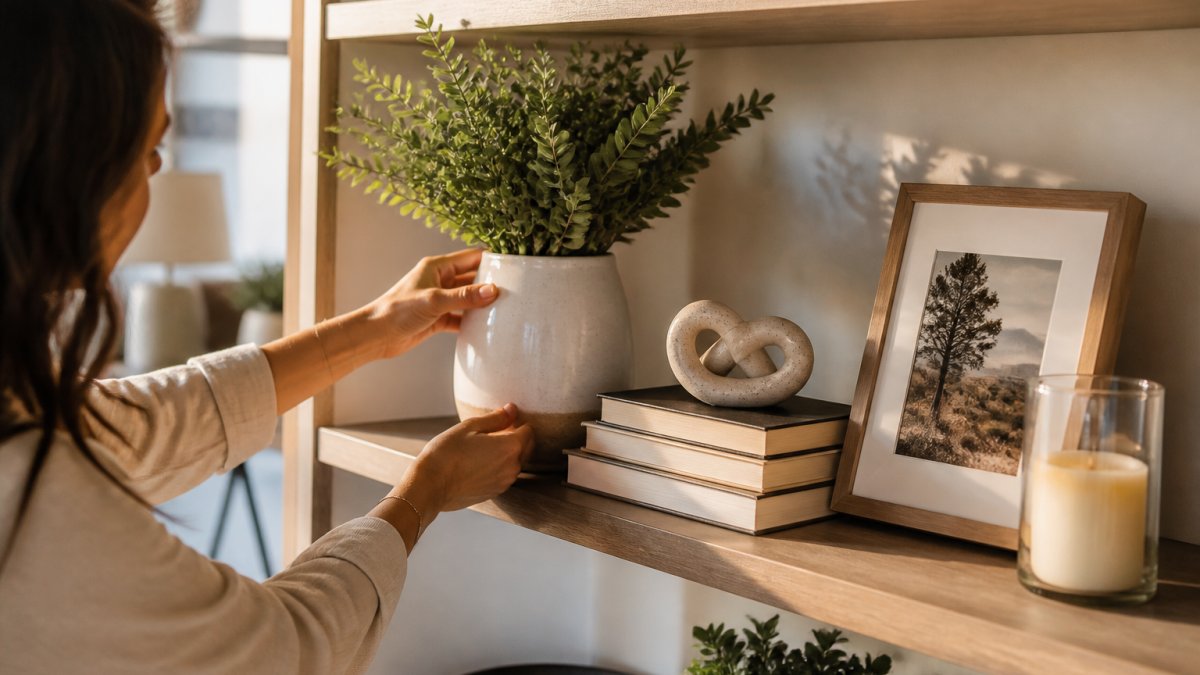
Here is a simple way to build the grouping:
- Place the tallest item first, slightly off center
- Add the widest item on the opposite side
- Fill the middle with a smaller object
- Tuck in a stack of books or a low bowl
- Finish with something soft, like a small plant or candle
Leave some empty space between items, negative space keeps a shelf from looking like a storage unit. On a 10-inch-deep shelf, a 2- to 3-inch gap reads as intentional breathing room; on a 6-inch-deep shelf, 1 inch is enough.
Shelf Styling for Small Spaces and Rentals
Small shelves and rental units need the same logic, scaled down. Three objects is usually enough on a narrow shelf or windowsill.
Renters should avoid anything requiring drilling or permanent fixes. Freestanding objects, lightweight vases, and small arrangements do the job without leaving a mark. For height without a wall anchor, stack two or three hardcover books horizontally and place a small object on top.
Surface-by-Surface Counts That Actually Work
Use these starting points and adjust by eye:
- Bedside table: three objects. One lamp, one small stack of books, one small decorative item. Five will crowd a standard 18- to 24-inch-wide nightstand.
- Entry console: five objects. A tray or bowl for keys, a tall vase or lamp, a stack of books, a small sculpture, and a candle. The tray doubles as a catch-all, which keeps the display functional.
- Coffee table: three to five objects, depending on table length. A 48-inch table handles five; a 36-inch round table handles three. Always leave at least one-third of the surface clear for drinks or a laptop.
These counts are starting points, not rules. The goal is a grouping that feels complete without feeling packed. If you can slide a hand between every object without touching two at once, you probably have room for one more. If you cannot set down a coffee cup, you have too many.
When Seven Is Too Many
Seven objects can overwhelm a small room, a rental, or any surface that also needs to work. In those cases, use the rule in reverse: start with three, then add one at a time until the surface feels finished, and stop before it feels full.
The rule is a tool for editing, not a quota. If three objects tell the story, three is the right number.
How to Decorate a Mantel With Odd-Numbered Groupings
Decorating a mantel follows the same rule, but the mantel's width and the fireplace below change the math. A standard mantel works well with five objects; a long one can take seven.
A common approach is to mirror the two ends loosely, then break the symmetry in the middle: a tall candlestick on one side, a framed piece on the other, and three smaller items clustered between.
Avoid hanging anything low enough to catch heat or block the fireplace opening. Safety comes before styling every time.
A Practical Method for Selecting and Arranging Objects
Choosing objects is easier when you sort them before you place them. Pull everything you might use onto the floor or table, then group by height and material.
Try this selection method:
- Pick one anchor piece, the largest or most eye-catching item
- Choose two supporting pieces that differ in height from the anchor
- Add one textured item, like a woven basket or a rough ceramic
Once the group is set, step back and look from across the room. If your eye jumps around, remove one item; if it feels flat, raise something on a stack of books.
Artificial Boston Fern Arrangement in Black Ribbed Stoneware Vase →
A Repeatable Five-Step Sequence
A fixed sequence removes the guesswork. Run these steps in order:
- Anchor. Place the largest or most visually heavy object first, slightly off center. This is the piece the eye should land on first.
- Counterweight. Add a second object of similar visual weight but different height on the opposite side. This creates the asymmetry that makes odd groupings work.
- Bridge. Place a medium-height object between the anchor and the counterweight, slightly forward or back to add depth.
- Texture and softness. Add one rough or woven item and one soft item, such as greenery or fabric. These two additions usually complete a group of five.
- Edit. Step back. Remove one object. If the display still reads as complete, leave it out. If it feels empty, put it back and remove a different one.
The edit step is the one most people skip, and it separates a styled surface from a cluttered one. Remove the smallest object first, since small items tend to read as clutter rather than detail.
Spacing, Height, and Depth Rules of Thumb
- Height: aim for three distinct heights, tall, medium, and low. If two objects are within an inch of each other in height, separate them or restack one on a book.
- Spacing: leave roughly one object-width between items on a shelf, and a bit more on a coffee table so the surface stays usable.
- Depth: stagger objects front to back rather than lining them up. A small object placed slightly forward of a larger one adds dimension without adding count.
Accessibility, Safety, and Functional Constraints
A display that looks good but does not work will not last. Keep these constraints in mind:
- Stable placement. Heavy ceramic or stone pieces belong on low, wide surfaces, not on high narrow shelves where a bump or a pet can send them down.
- Clear walkways. Keep at least 36 inches of clear path in main walkways and 32 inches in secondary ones. Do not let a console or entry display narrow a doorway.
- Reachable storage. If a surface doubles as storage, keep frequently used items at arm's reach and reserve the top of a tall bookcase for display only.
Varying Height, Scale, and Texture
Height variation is what makes an odd grouping read as a composition instead of a lineup. Aim for three distinct heights: tall, medium, and low. Scale matters too, a tiny object next to a huge one looks lost, so keep sizes within a reasonable range.

Texture adds depth. Mix smooth ceramic with rough stone, or soft fabric with hard metal. A tight color palette with varied textures usually looks more polished than a rainbow of objects.
When Even Numbers Work Better
The 3-5-7 rule is a flexible styling guideline, not a universal design law. Even-numbered symmetry can work better in specific cases:
- Symmetrical fireplace setups, where matching sides create formal balance
- Minimalist rooms, where a single strong object or a matched pair is the whole point
- Gallery walls, where art carries the visual weight and accessories would compete
Use the rule when a surface feels flat or cluttered. Skip it when the space already works. The best test is simple: if the arrangement looks finished and functions well, the count is correct.
Decorating With Faux Plants: Zero-Maintenance Greenery That Fits the Rule
Decorating with faux plants solves two problems at once: they add the soft, organic element every grouping needs, and they never wilt, ideal for busy schedules, low-light rooms, and pet-friendly homes.
At Spotteddonkey, we build our arrangements from non-toxic materials, so they work in homes with cats and dogs. Our pieces are also made to hold their look in harsh climates, which matters if your home swings between dry heat and air conditioning. A few options that fit neatly into a three, five, or seven grouping:
- The Artificial Greenery Stem Arrangement in White Minimalist Ceramic Vase at $19.99 works as a low, clean accent
- The Artificial Viburnum Spray Arrangement in Handcrafted Circular Ceramic Vase at $36.99 adds a medium-height element
- The Artificial Spiral Eucalyptus Arrangement in Grey Pebble Ceramic Vase at $45.99 brings height and soft texture
- The Artificial Boston Fern Arrangement in Black Ribbed Stoneware Vase at $88.57 acts as a bold anchor piece
One note on care: faux greenery still collects dust. A quick pass with a dry cloth every few weeks keeps it looking fresh, which is far less work than watering a live plant.


Common Mistakes to Avoid and When the Rule Is Optional
The first mistake is treating the count as law. The 3-5-7 rule is a guide, not a building code.
The second mistake is ignoring scale.
The third mistake is skipping the edit. After you arrange a group, remove one item and see how it looks.
The rule is optional in a few cases:
- Symmetrical fireplace setups, where balance comes from matching sides
- Minimalist rooms, where one strong object is the whole point
- Gallery walls, where art carries the visual weight
Use the rule when a surface feels flat or cluttered. Skip it when the space already works.
Conclusion: Making the 3-5-7 Rule Work in Your Home
The hardest part of styling a shelf or mantel is knowing when to stop adding. The 3-5-7 rule gives you a clear place to stop, and odd numbers give the group a natural, lived-in feel.
Spotteddonkey can help you fill those groups with greenery that never needs water. Our hyper-realistic faux plants are crafted from non-toxic materials, safe for pets, and built to keep their color and shape over time.
Frequently Asked Questions
What is the difference between the rule of three and the 3-5-7 rule?
The rule of three in interior design says any grouping of three objects reads as a complete set, so it is the smallest odd grouping that works. The 3-5-7 rule is a broader version: it treats three, five, and seven as the group sizes that scale with the surface. A side table takes three objects, a console table takes five, and a large bookcase or mantel takes seven. The rule of three is one option inside the 3-5-7 rule, not a competing idea.
How do you use the 3-5-7 rule to style a shelf?
Pick a group size that matches the shelf width: three objects on a narrow shelf, five on a standard one, seven across a wide bookcase. Then vary height so the tallest piece sits off-center, and mix materials such as ceramic, wood, glass, and greenery. Leave negative space between groups so each vignette reads on its own. If a shelf looks cluttered, remove one item rather than adding another.
Can you use the 3-5-7 rule with plants and other natural-looking decor?
Yes. Greenery is one of the easiest ways to hit an odd number because a single stem or arrangement counts as one object. Decorating with faux plants works especially well here: a Boston fern arrangement in a ribbed stoneware vase or a spiral eucalyptus arrangement can serve as the tall anchor piece in a group of three or five, and it will not wilt, drop leaves, or need watering while you are away.
Does the 3-5-7 rule work in every room?
It works on almost any surface that holds decor: shelves, mantels, coffee tables, console tables, side tables, and entryway benches. The rule is a starting point, not a law. Very small surfaces, such as a narrow windowsill, may only fit one or two objects, and that is fine. Match the group size to the space you actually have rather than forcing seven objects onto a surface that cannot hold them.
Ready to refresh a shelf, mantel, or console table? Shop the full Spotteddonkey catalog and build a display that looks styled, not staged, with zero maintenance required.